Short answer: a winning web design proposal is short, specific and easy to say yes to. It restates the client’s problem in their words, defines exactly what is (and isn’t) included, offers three priced options, sets clear payment terms, and ends with one obvious next step. Below is the 9-section structure and a copy-and-paste template.
What a web design proposal is (and isn’t)
A proposal is a sales document: its job is to get a decision. It is not the contract (that covers legal terms like liability and ownership) and it is not a full project plan. Keep it to 2–4 pages or one scrolling page. Long proposals get skimmed, and the pricing section is what clients read first anyway.
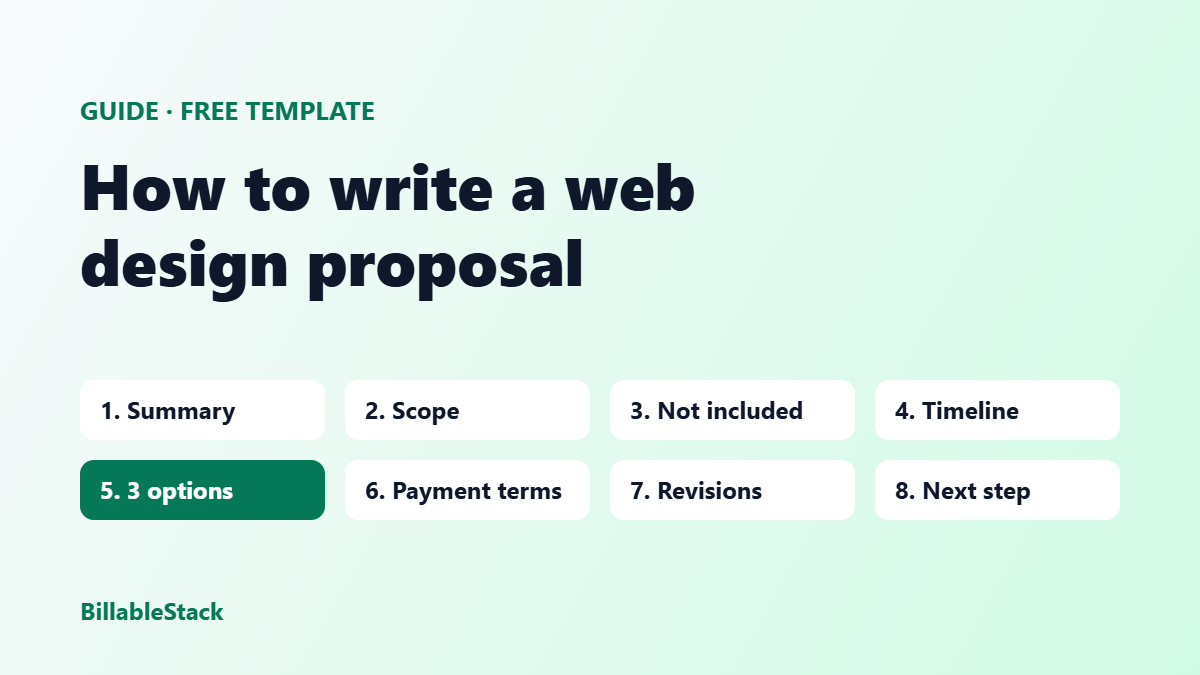
The 9 sections every web design proposal needs
1. A one-paragraph summary
Open with the client’s goal, not your bio. “Northside Bakery wants a website that lets customers see the menu and order cakes online, so the phone stops ringing all day.” If the client nods at this paragraph, you are halfway there.
2. The problem, in their words
Reuse the exact phrases the client used on your discovery call: “the site looks outdated on phones”, “we lose orders on weekends”. It shows you listened, and it frames your price against a problem that costs them money.
3. Scope: what’s included
List deliverables concretely: number of pages, which pages, contact or order forms, basic SEO setup, mobile optimization, training session. Vague scope is the #1 cause of scope creep.
4. Scope: what’s not included
This short list saves more arguments than any other section: copywriting, photography, logo design, ongoing maintenance, paid plugins or premium themes, extra revision rounds. Each can be offered as an add-on.
5. Timeline and milestones
Give a realistic schedule with milestones (design approval, development, launch) and state what you need from the client and when: content, photos, feedback within X days. Make it clear that delays in client content move the launch date.
6. Three pricing options
Offer three packages instead of one price. It changes the client’s question from “should I hire this person?” to “which option do I want?”. Make the middle option the one you actually recommend.
| Essential | Recommended | Premium | |
|---|---|---|---|
| Pages | Up to 3 | Up to 5 | Up to 8 |
| Online ordering / booking | — | ✓ | ✓ |
| Basic SEO setup | ✓ | ✓ | ✓ |
| Revision rounds | 1 | 2 | 3 |
| Training session | — | 30 min | 60 min |
| 3 months of care plan | — | — | ✓ |
| Price (example) | $1,500 | $2,700 | $4,200 |
Example prices only. Not sure what to charge? Use our freelance hourly rate formula to price each package from your estimated hours.
7. Payment terms
Spell out how and when you get paid. A common structure for small business websites is 50% deposit to start, 50% before launch; larger projects often use 40/30/30 milestones. Include accepted payment methods, the due period (for example, 7 days) and what happens with late payments.
8. Revisions and approvals
State how many revision rounds each package includes and your rate for extra rounds. Define what counts as a revision (changes to the approved design) versus new work (new pages or features).
9. Next step
End with one clear action: “Choose a package and sign below to reserve your start date of March 3.” Add an expiry date (14 days is common) so the proposal doesn’t sit in an inbox forever.
Copy-and-paste proposal template
Replace the brackets and adapt the tone to your client:
WEBSITE PROPOSAL FOR [CLIENT NAME]
Prepared by [Your name] · [Date] · Valid until [Date + 14 days]

1. SUMMARY
[Client] wants [goal] so that [business result].

2. WHAT WE HEARD
- "[Problem in client's words]"
- "[Problem in client's words]"

3. WHAT'S INCLUDED
- [Number] pages: [Home, About, Services, ...]
- [Contact / booking / order form]
- Mobile-friendly design and basic SEO setup
- [Training session]

4. NOT INCLUDED (available as add-ons)
- Copywriting · Photography · Logo design · Ongoing maintenance

5. TIMELINE
- Week 1: Discovery and content collection
- Week 2-3: Design and your feedback
- Week 4-5: Development and testing
- Week 6: Launch
I need all content by [date] to keep this schedule.

6. OPTIONS
- Essential: [scope] — $[price]
- Recommended: [scope] — $[price]
- Premium: [scope] — $[price]

7. PAYMENT TERMS
50% deposit to start, 50% before launch. Invoices due within 7 days.

8. REVISIONS
[2] rounds included. Extra rounds billed at $[rate]/hour.

9. NEXT STEP
Choose your option and sign below to reserve your start date of [date].
Tips that help proposals get signed
- Send it within 24 hours of the discovery call, while the client is still excited.
- Walk them through it live on a short call instead of just emailing a PDF. You can answer objections on the spot.
- Let them sign and pay in one step. Tools like HoneyBook and Bonsai combine proposal, contract and deposit invoice, which removes friction between “yes” and getting paid. See our HoneyBook pricing guide.
- Show 2–3 relevant examples of past work, ideally from the same industry.
- Follow up two or three days later if you have not heard back. A short, friendly check-in is enough.
Mistakes that kill web design proposals
- Starting with three pages about yourself instead of the client’s goal.
- A single take-it-or-leave-it price.
- Vague scope like “a modern website” with no page count.
- No deposit, or payment terms buried in the fine print.
- No expiry date or next step.
Frequently asked questions
How long should a web design proposal be?
Usually 2–4 pages, or one scrolling web page. Enough to define scope, price and terms clearly; anything longer tends to get skimmed.
Is a proposal the same as a contract?
No. The proposal describes the project and price; the contract covers legal terms such as ownership, liability, cancellation and confidentiality. Many freelancers send both together so the client can approve and sign in one go.
How much deposit should I ask for?
50% up front is common for small business websites. For larger projects, splitting payments by milestone (for example 40/30/30) is also widely used.
Should I include prices in the proposal?
Yes. Hiding prices only delays the decision. Presenting three options with clear prices usually works better than a single number.

Written by
Bryan Ruzafa, founder of BillableStack. This guide is based on standard freelance proposal practices. About · Our methodology