
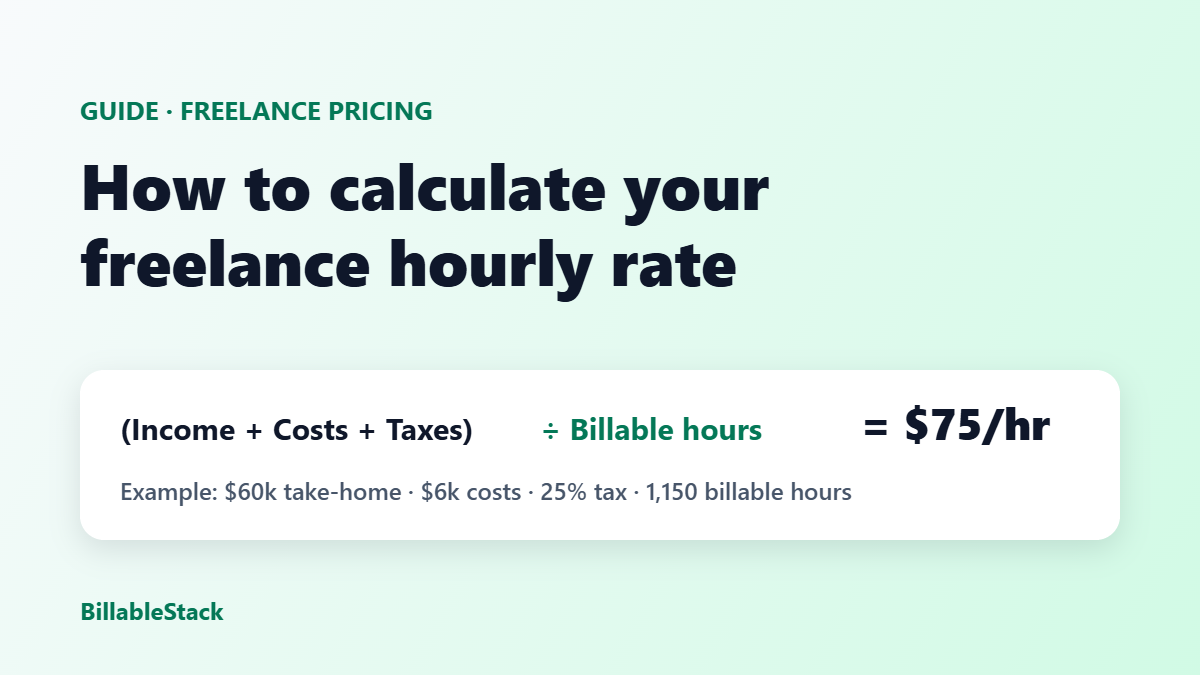
Short answer: your hourly rate = (the income you want + your business costs + taxes) ÷ the hours you can actually bill. For most full-time freelancers that is around 1,000–1,200 billable hours a year, not 2,080. Below is the step-by-step formula, a worked example, and a table you can use to sanity-check your number.
The formula
Hourly rate = (Target take-home pay + Business costs + Taxes) ÷ Billable hours per year
Then add a 10–20% buffer for slow months and unpaid work.
Why “salary ÷ 2,080” gives you the wrong rate
The classic mistake is taking the salary you would earn as an employee and dividing it by 2,080 hours (40 hours × 52 weeks). As a freelancer you pay for things an employer used to cover: software, hardware, health insurance, the employer half of payroll taxes, holidays, sick days and every hour you spend on sales, admin and email. None of those hours are billable, but they all have to be paid for by the hours that are.
Step 1: Decide your target take-home pay
Start with what you want to keep after taxes and business expenses: the number that pays your rent and your life. Be honest, and include savings and retirement contributions, because nobody else is contributing for you anymore.
Step 2: Add up your business costs
List everything the business pays for in a year. A typical freelance web designer might have:
| Cost | Example per year |
|---|---|
| Software (design tools, CRM/invoicing, hosting, email) | $1,800 |
| Hardware (laptop, monitor, replaced every ~3 years) | $1,000 |
| Health insurance (varies hugely by country and state) | $2,000+ |
| Accounting / tax help | $600 |
| Courses, books, conferences | $400 |
| Internet, phone, coworking share | $200 |
| Total | ~$6,000 |
These are example figures to show the method. Replace them with your own.
Step 3: Account for taxes
In the US, self-employed people pay self-employment tax (Social Security and Medicare, 15.3% on most of your net earnings) on top of income tax. A common rule of thumb is to set aside 25–30% of your profit for taxes, but your real number depends on your country, state and deductions, so confirm it with an accountant. The example below uses 25%.
Step 4: Estimate your real billable hours
This is where most rates go wrong. Work it out like this:
- Start with 52 weeks.
- Subtract vacation, public holidays and sick days. Around 6 weeks is realistic, which leaves ~46 working weeks.
- Multiply by the hours you can actually bill each week. Most freelancers spend 30–50% of their time on sales, admin, invoicing and learning, so 20–28 billable hours out of a 40-hour week is normal.
46 weeks × 25 billable hours = 1,150 billable hours a year. That is the number we will use.
Worked example: from $60,000 take-home to an hourly rate
| Step | Calculation | Result |
|---|---|---|
| Target take-home pay | — | $60,000 |
| Profit needed before 25% tax | $60,000 ÷ 0.75 | $80,000 |
| Add business costs | $80,000 + $6,000 | $86,000 revenue needed |
| Billable hours | 46 weeks × 25 hours | 1,150 hours |
| Base hourly rate | $86,000 ÷ 1,150 | $75/hour |
| With a 15% buffer | $75 × 1.15 | ~$85/hour |
So a freelancer who wants to take home $60,000 needs to charge roughly $75–85 an hour, not the $29 you would get from $60,000 ÷ 2,080.
Quick reference table
Using the same assumptions ($6,000 costs, 25% tax, 1,150 billable hours, no buffer):
| Target take-home | Revenue needed | Minimum hourly rate |
|---|---|---|
| $40,000 | ~$59,300 | ~$52 |
| $60,000 | $86,000 | ~$75 |
| $80,000 | ~$112,700 | ~$98 |
| $100,000 | ~$139,300 | ~$121 |
Turning your hourly rate into project prices
Clients usually prefer a fixed price, and fixed prices protect you when you get faster. Estimate the hours, multiply by your rate, then round:
- Small business website, 5 pages: ~32 hours × $85 = $2,720, so quote $2,700.
- Landing page: ~12 hours × $85 = $1,020, so quote $1,000.
- Monthly care plan (updates, backups, small edits): ~3 hours × $85 = $255, so quote $250/month.
Always add a line for revisions (for example, “two rounds included”) and charge extra rounds at your hourly rate. For larger projects, ask for a deposit; 50% up front is common.
Common mistakes to avoid
- Dividing by 2,080 hours instead of your real billable hours.
- Forgetting taxes and pricing as if you keep 100% of every invoice.
- Not raising rates. Review your rate every 6–12 months, or whenever you are booked solid.
- Not tracking time. You can’t know your real effective rate on fixed-price projects unless you track hours. Tools like Bonsai include time tracking, and simple timers work too.
- Ignoring payment fees: card fees of around 3% come straight out of your rate (see our HoneyBook pricing breakdown for an example).
Frequently asked questions
What is a good hourly rate for a beginner freelancer?
Run the formula with your real costs and the minimum you need to live on; that is your floor. Beginners often charge below the formula to win first clients, but avoid going so low that you need 40 billable hours a week to survive. That is not sustainable.
Should I charge hourly or per project?
Use your hourly rate to calculate prices, but quote fixed project prices whenever the scope is clear. Hourly billing makes sense for open-ended work like maintenance, consulting or unclear scopes.
How many billable hours can a freelancer realistically work?
Most full-time freelancers bill somewhere between 20 and 30 hours a week once sales, admin and learning are accounted for, which works out to roughly 900–1,400 billable hours a year.
How often should I raise my rates?
Every 6–12 months is a common rhythm, and always when you are consistently fully booked. Give existing clients notice (30 days is typical) before a new rate applies to them.

Written by
Bryan Ruzafa, founder of BillableStack. This guide explains a calculation method; check tax figures for your own country with a qualified accountant. About · Our methodology